

Dummy pages, Gene Krupa and his Columbia recording orchestra, demo booklet, 1941, part of a series of homemade samples prepared by Flora for the Columbia Records art department. Most pages from the booklets (which earned the artist a job at Columbia) were reproduced in The Curiously Sinister Art of Jim Flora; three of the above four pages were omitted due to space constraints. We posted another unpublished page from the series here and more Flora…
Continue Reading... Gene Krupa demo booklet (1941) ►
Detail (about two-thirds of the complete work) of an untitled, unpublished tempera on board, ca. mid-1960s. The collection contains a number of similarly composed maritime paintings from this period, though colors and figures vary. If you have our recent book, The Sweetly Diabolic Art of Jim Flora, compare this setting with Salt Pond—Block Island on page 54.
Continue Reading... seaside setting ►
… this time to a distant galaxy. Or maybe just down the block to the Moon. The genre-surfing Seattle combo has once again (third time) licensed a Jim Flora illustration for a cover, their new 7″ vinyl release Agendacide. The above element derives from the April 1963 cover of Computer Design magazine. Previously the band’s John Ewing licensed images for the Reptet’s CDs Do This! and Chicken or Beef. This helps carry the Flora mid-20th…
Continue Reading... Reptet rides again ►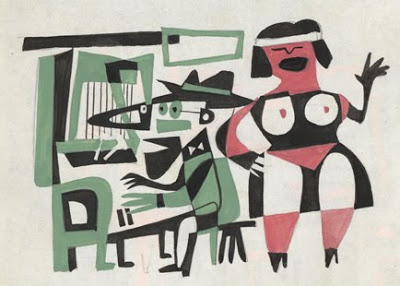
Here are two tempera illustrations discovered in an early- to mid-1960s sketchpad in the Flora collection. The more refined of the two works has a title: Bessie Smith, presumably a vignette of the soulful, bawdy 1920s and ’30s Empress of the Blues. The pianist (great hat!) is unidentified, and we can’t vouch for the historical accuracy of Smith performing with her nipples exposed: The second work, pages away in the same sketchpad, is untitled but…
Continue Reading... Bessie Smith and someone like Bessie Smith ►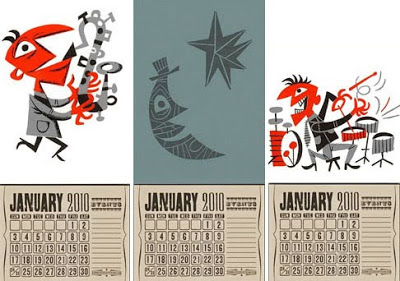
We’ve received no reports of malfunctioning 2009 calendars—every day has thus far been accounted for, in the correct sequence—so we’re offering 2010 models, hot off Yee-Haw’s industrial presses. The spunky hyperactive figures date from Flora’s mid-1950s RCA Victor LP period. Each calendar is letterpress printed one color at a time on card stock, and accessorized with a 12-month tearaway calendar. Buy one ($12.50) or a set of three at the Little Shop of Flora’s.
Continue Reading... Jim Flora 2010 calendars available ►
Taking a break from conjuring bonus-limbed mutants and bug-eyed boppers, Flora often sketched maritime culture in his extended backyard. The above untitled pen & ink of a seafood shack was discovered in a travel sketchbook that contained dozens of the artist’s impressions of Italy and France, several dated 1962. Back on his “home surf,” Flora filled another two dozen pages of the tablet with southern Connecticut shoreline vignettes and briny motifs.
Continue Reading... Lobster Pound (1962) ►
Eric Reynolds has worked at Fantagraphics (our Flora books publisher) for 15 years, mostly as publicist. It’s been our pleasure to conduct business with (and, in September 2007, meet) the affable Mr. Reynolds, an admitted Floraphile. He was recently booted upstairs by his bosses to the position of Associate Publisher. A large round of applause for that company move (though we’ll miss Eric on the PR end). Comic Book Galaxy’s Trouble With Comics blog tendered…
Continue Reading... 5Qs 4 Eric Reynolds ►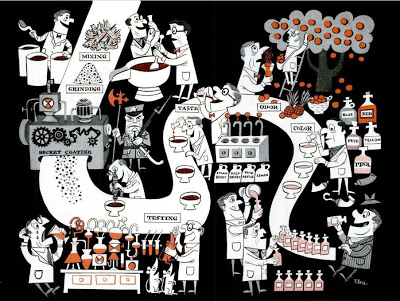
Feature illustration, “A Long-Playing Medicine”LIFE magazine, June 10, 1957
Continue Reading... odyssey of a drug ►Flora rendered the above woodcut for the cover of a collection of short stories by Alvin Frederick Levin, published by Little Man Press in 1940. New Directions Books has just issued Love Is Like Park Avenue, Levin’s “unfinished novel,” which includes the “Little Alvin” vignettes and a reproduction of Flora’s woodcut. You’ve probably never heard of Alvin Levin. Neither had we. The intriguing rediscovery of Levin is chronicled by New Directions Senior Editor Declan Spring…
Continue Reading... Love Is Like Park Avenue ►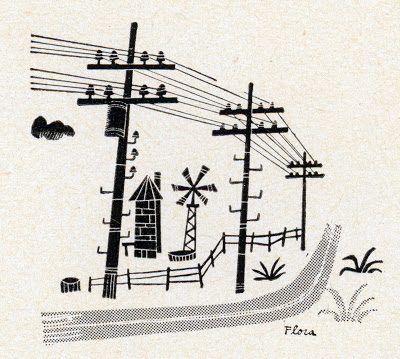
Spot illo, “New Competition for G.E.,” a brief 1953 article about Continental Electric Equipment Co. of Kentucky.
Continue Reading... rural electrification ►
