
Filed Under: "1940s"
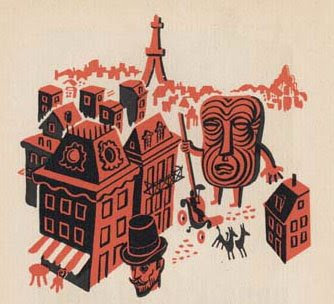
Paris had this unnamed gargantuan invader. In the foreground, a Van Dyke-bearded, top-hatted anatomical spare part flees from impending carnage, his method of self-propulsion unknown. Spot illustration, Columbia Coda, Nov-Dec. 1943, having something to do with composer Frederick Delius—but after reading the booklet’s accompanying text, we’re not certain what.
Continue Reading... Tokyo had Godzilla … ►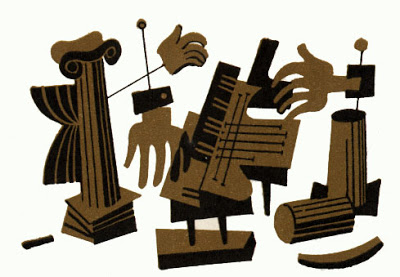
Spot illustration, table of contents page Columbia Disc Digest, April 1946
Continue Reading... hands, columns, keyboard ►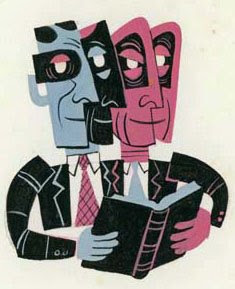
One of over 40 pocket-sized tempera illustrations Flora rendered in the mid-1940s for an apparently never-published edition of Thomas Wolfe‘s Look Homeward, Angel. Illustrations survive for all chapters save one (chapter 30), as well as for the title page, colophon (above), and the book’s three sectional divides. No documentation exists in the archives explaining the destiny or disposition of the series. Several illustrations were published in The Curiously Sinister Art of Jim Flora; the rest…
Continue Reading... Look Homeward, Angel (colophon) ►
The Rover Boys, tempera on board, ca. 1943. The work was presented as a wedding gift to Clara Gee Kastner and Stanley Stamaty, Flora’s classmates and friends from the Art Academy of Cincinnati. (Clara and Stan are the parents of cartoonist Mark Alan Stamaty.) No idea if the triple-headed figure was intended to portray the Rover lads of literary fame. The work was reproduced in The Curiously Sinister Art of Jim Flora A pen and…
Continue Reading... The Rover Boys ►
Pencil sketch, ca. 1940-42. A refined wood- or linocut of this critter appeared in the 1942 Little Man Press chapbook GUP, one of many Flora spot illustrations adorning the Robert Lowry story “The Hotel.”
Continue Reading... spotted kitteh ►
Pencil sketch, early 1940s. Pulled-apart facial features linked by pin-lines is a common motif in early 1940s Flora sketches and paintings. Previous examples here, here, here, here, here, here, and here.
Continue Reading... another from the skull gallery ►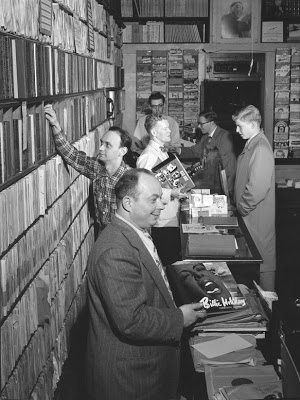
Floraphile Cary Ginell dropped us a note: Just ran across this image in the Library of Congress archives. It’s a shot taken by William Gottlieb of the Commodore Record Shop in New York in 1947. Check out the guy in the middle of the photo. He’s getting ready to purchase (or sell, if he’s a counter clerk) the Kid Ory Columbia 78 album with Flora’s artwork. BTW, the guy reaching up to pull something from…
Continue Reading... Flora at the Commodore ►
Robert Lowry (1919-1994) would turn 90 today. Don’t expect a presidential proclamation in commemoration of this troubled man’s legacy. However, we salute the Little Man Press writer/editor for changing the course of Flora’s career, and probably for influencing his art. It all began one day in 1938 when the volatile literary turbine accosted Flora on the Art Academy of Cincinnati campus and demanded the undergrad illustrator serve as art director for his fledgling independent press…
Continue Reading... Robert Lowry @ 90 ►
Detail, Columbia Broadcasting System trade brochure, 1943 or ’44
Continue Reading... radio: the better ticket to reach customers ►
Born this day in 1916. In 1939 the trumpeter, already a top-tier bandleader, hired a smooth, upcoming but relatively unknown vocalist from New Jersey, but failed to convince the kid to change his name to “Frankie Satin.” Within a year, James and singer had parted ways, the latter to join Tommy Dorsey’s orchestra. Within a few years, both James and the kid crooner were on their respective ways to becoming music legends. Columbia Records ad…
Continue Reading... Happy Birthday, Harry! ►
Leon Bix Beiderbecke was born today in 1903. Beiderbecke, a cornetist (caricatured above left by Flora in 1947) and pianist, was a stylistic catalyst in the formative years of jazz. Bix and trumpeter Louis Armstrong were the two most pivotal horn players of the 1920s, though their approaches differed markedly. Beiderbecke has been described as the first real modernist in jazz, though that doesn’t explain his enduring appeal. (Each year when the calendar flips to…
Continue Reading... Bix @ 106 ►
Woodcut print accompanying Robert Lowry‘s short story, “March Morning,” page 36, Hutton Street (Little Man Press, 1940). This 7-1/2″ x 5″ chapbook contains 18 meticulous woodengravings by Flora. Whereabouts of the original blocks is (ahem!) unknown.
Continue Reading... March Morning ►
