
Filed Under: "commercial illustrations"

Commercial spot illustration, ca. 1960, magazine and article unknown. The theme is obvious: agriculture, broadcasting, and oil moguls attempt to steer public policy by channeling self-interest through a politician’s bully pulpit. Pen & ink with black tempera on vellum with printer’s markings.
Continue Reading... political patrons ►
Commercial spot illustration, 1961, magazine and subject unknown. Pen & ink, watercolor and Liquid Paper on artist board with printer’s markings. Time-traveler Buster Keaton found himself in a similar predicament in the legendary Twilight Zone episode “Once Upon a Time,” which aired the same year.
Continue Reading... rush hour ►
The miserable family road trip. Commercial spot illustration, 1958, magazine and subject unknown. Pen & ink and watercolor on artist board. Three additional thematically unrelated spot illos were arrayed on the board.
Continue Reading... road rage (1958) ►
Detail of large-scale illustration for “A Meeting of the Clan at a State Park,” article in New York Times, October 14, 1956. This detail, reproduced (with the full illustration) in our second anthology, The Curiously Sinister Art of Jim Flora, is from a rejected version of the assignment found in the Flora family archives. The published version has similar elements, but repositioned.
Continue Reading... Meeting of the Clan (part 1) ►
Detail from panoramic illustration for article “Arts and the Man,” Park East magazine, May 1953. Flora served as the publication’s art director in 1952, but moved on to full-time freelancing in January 1953. His successor in the Park East AD chair was his longtime colleague Robert M. Jones, who had also succeeded Flora as AD at Columbia Records in 1945. Jones jobbed out several Park East illustration assignments to Flora. The following year, Jones was…
Continue Reading... Arts and the Man (part 1) ►
Spot illustration for “The Patented Gate and the Mean Hamburger,” a short story by Robert Penn Warren which appeared in the January 1947 issue of Mademoiselle magazine. At the time Flora was employed at Columbia Records, but having been promoted out of the art department and focusing largely on bureaucratic tasks (much to his displeasure), he was seeking outside freelance work. His first assignment for Mademoiselle, for Robert Lowry’s “Little Baseball World,” had appeared in…
Continue Reading... The Patented Gate & the Mean Hamburger ►
Partial illustration, “What is Automation,” Collier’s magazine, March 16, 1956. Pull quote from the layout: Automation has been heralded by some as the threshold to a new Utopia, in which robots do all the work while human drones recline in pneumatic bliss. The complete two-tiered illustration—half-utopian (above), half-apocalyptic—was reproduced in our second anthology, The Curiously Sinister Art of Jim Flora.
Continue Reading... What Is Automation? (part 1) ►
Spot illustration, April 1946 Columbia Records Disc Digest, a monthly “commentary on the new Columbia Masterworks and popular records plus interesting features on the artists who make them.” DD was the successor to Flora’s popular monthly Coda, which he created for the label in 1943. Coda was seemingly “retired” when Flora was promoted from Art Director to Advertising Manager in 1945. He illustrated all issues of Coda, but very few DDs. Here’s Flora’s cover for…
Continue Reading... music amid the ruins ►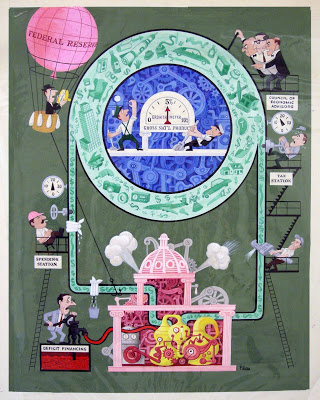
The above tempera on illustration board by Flora was recently purchased by a fabulous financial blogger. The Rube Goldberg-like catalytic pipeline originally appeared in the December 1964 issue of Fortune magazine accompanying an article entitled “A New Turn in Taxes.” Most of Flora’s work-for-hire illustrations from the 1940s and 1950s cannot be located, having been kept (or disposed of) by client art directors. Judging by what’s in the Flora family collection, starting in the late…
Continue Reading... A New Turn in Taxes ►
Hot Stove League entry: illustration (one of several) from “The Big Leagues Are Killing Baseball,” LOOK magazine, April 15, 1958. The above image is an original painting. Many of Flora’s early commercial illustrations exist only as printed reproductions, the original art either kept by the magazines or thrown out. When I interviewed Flora in 1998, I asked him about the whereabouts of his commercial originals. “They would reproduce it,” I queried, “but they wouldn’t think…
Continue Reading... the business of baseball ►
Detail, “Furnished,” Primer for Prophets alphabet series, 1954. We’ve issued 12 letters as limited edition screen prints, but “F(urnished)” is still in the deep freeze. The full print isn’t as disturbing as the above detail suggests—the husband beyond the crop hasn’t lost his cool. All shall be revealed by the time we complete the series.
Continue Reading... domestic disturbance ►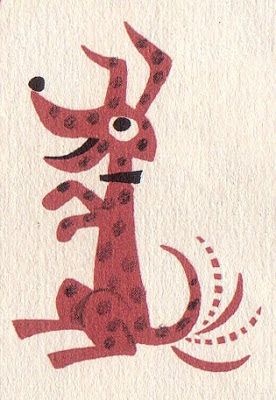
Detail, “Raided,” Primer for Prophets alphabet series, 1954. We’ve issued 12 letters as limited edition screen prints, but “R” remains on our to-do list.
Continue Reading... tail wagger ►
