
Filed Under: "instruments"

Flora “Rhapsody (in Blue)“ wallpaper by Astek and Double-E featured on the Babyccino blog: Writes Pim’s mom Esther: Last weekend, my husband and I did something new for both of us: we wallpapered a wall. We learned a lot about measuring, cutting, and patience, and got to deeply respect the skills of professional wallpaperers. But after hard labour I’m proud to present the results: the wall behind Pim’s bed is covered in gorgeous blue wallpaper!…
Continue Reading... Pim’s bed and Flora wallpaper ►
Another Flora album cover—although in this case the product is digital-only. The illustration originally appeared in the December 1945 issue of Columbia’s Coda new-release monthly, which Flora wrote, edited, and illustrated for three years. The detail was adapted for this digital album cover by Flora co-archivist Irwin Chusid, who also represents the Sun Ra estate. The album is available at iTunes. Flora’s album cover legacy has extended into the 21st century, with designers adapting his images…
Continue Reading... Sun Ra: Solo Piano (a la Flora) ►
Leon “Bix” Beiderbecke (1903-1931) Today is the 109th birthday of Leon “Bix” Beiderbecke, an American “hot jazz” legend who’s been dead for 81 of those years. Bix was an alcoholic who never took a legal drink in his life. He was underage when Prohibition commenced in 1919, and died before it was repealed in 1933. Jim Flora, who loved jazz, rendered a caricature of this revered cornetist on a 1947 Columbia Records 4-disc set. Last…
Continue Reading... Bix, birthday boy (and Flora tattoo #3) ►
Today we launch a new limited edition fine art print of a classic mid-century Flora album cover. Bix and Tram was one of the artist’s earliest record sleeve illustrations, issued by Columbia in 1947 on a 78 rpm 4-disc set. The cover features outlandish caricatures of two legendary bandmates from the 1920s “hot jazz” scene: cornetist Leon “Bix” Beiderbecke and saxophonist Frankie Trumbauer. Despite what appear to be mutant facial and cranial features, in fact…
Continue Reading... Bix & Tram print released ►
Jim Flora Art has launched a new limited edition fine art print: INSIDE SAUTER-FINEGAN, a 1954 RCA Victor LP that features one of Flora’s best-known cover illustrations. Eddie Sauter and Bill Finegan were famous for their orchestral mayhem. While Flora’s mischievous cover figures didn’t physically resemble Eddie or Bill, his caricatures reflected their inventive approach to redefining big band jazz in the 1950s. The print image is larger (15-1/2″ square) than the 12″ square LP….
Continue Reading... Inside Sauter-Finegan (print) ►
Previously uncirculated pen and ink from sketchbook, 1995. From the 1920s to his death in 1974, Duke Ellington saw musicians come and go. Saxophonist/clarinetist Harry Carney (b. Boston, 1910) devoted 46 years to performing and recording with the maestro. The trusty sideman occasionally conducted the orchestra in Duke’s absence. After Ellington’s death, Carney was quoted as saying, “This is the worst day of my life. Without Duke I have nothing to live for.” Four months…
Continue Reading... The Duke and Harry Carney ►
Partial illustration, “What is Automation,” Collier’s magazine, March 16, 1956. Pull quote from the layout: Automation has been heralded by some as the threshold to a new Utopia, in which robots do all the work while human drones recline in pneumatic bliss. The complete two-tiered illustration—half-utopian (above), half-apocalyptic—was reproduced in our second anthology, The Curiously Sinister Art of Jim Flora.
Continue Reading... What Is Automation? (part 1) ►
Spot illustration, April 1946 Columbia Records Disc Digest, a monthly “commentary on the new Columbia Masterworks and popular records plus interesting features on the artists who make them.” DD was the successor to Flora’s popular monthly Coda, which he created for the label in 1943. Coda was seemingly “retired” when Flora was promoted from Art Director to Advertising Manager in 1945. He illustrated all issues of Coda, but very few DDs. Here’s Flora’s cover for…
Continue Reading... music amid the ruins ►
Peter Ceragioli Jr. was born this day in 1932. You may not recognize this West Coast jazz pianist, accordionist, and composer by his birth name. Beyond TV and film soundtrack cognoscenti, he’s probably obscure even by his stage name—Pete Jolly. The keyboardist was a child prodigy on accordion, as spaceagepop.com points out: When he was eight, he made his first broadcast appearance, billed as “The Boy Wonder Accordionist” on CBS Radio’s Hobby Lobby. The show’s…
Continue Reading... Jolly birthday ►
Jazz clarinetist Benny Goodman, as portrayed by Flora for the March 1952 issue of Columbia’s monthly Coda new release booklet. Goodman was a founding father of the mid-1930s jazz big band (“swing”) style—launched in force after he hired arranger Fletcher Henderson in 1935. As he matured, he performed and recorded classical repertoire; the above figures illustrated Coda’s preview of Goodman’s recording (with the American Art Quartet) of Mozart’s Quintet for Clarinet and Strings. Flora was…
Continue Reading... Benny Goodman @ 101 ►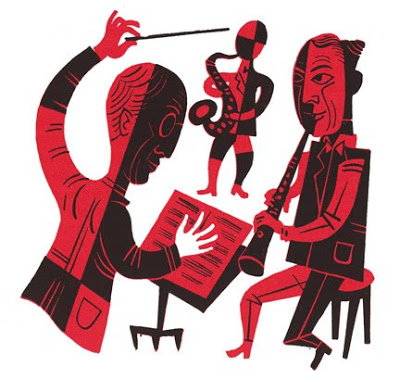
Bandleader/clarinetist Woodrow Charles “Woody” Herman (1913-1987) rendered by Flora in the June 1946 issue of Columbia Records Disc Digest. Flora used alternating-color patterns throughout his career (see examples here, here and here). Because he was partly color-blind, skin tints were irrelevant. Herman was born today 97 years ago (less than a year before Flora).
Continue Reading... Woody Herman ►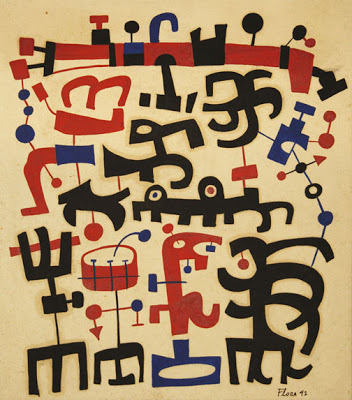
Fletcher Henderson, tempera on paper, 1942, as reproduced in our third anthology, The Sweetly Diabolic Art of Jim Flora. In the 1920s, exploring ideas gleaned from orchestra leader Paul Whiteman, pianist Henderson created the template for what evolved into the jazz “swing” big bands of the 1930s. He was one of the most influential musicians/bandleaders of the 1920s, but others achieved greater and more lasting fame developing concepts pioneered by Henderson. Flora, a lifelong jazz…
Continue Reading... Fletcher Henderson ►
