

We launched our latest Jim Flora fine art print, G3 in Tampico (detail, left), earlier this week. The original 1970 tempera painting on artist board is shelved in storage at the Flora collection in Norwalk, Connecticut. The title is an enigma, but so are the figures (full work below). Here’s a peek at the selection and restoration process behind our fine art prints. The Flora catalog is huge; as co-archivists, Barb Economon and I have…
Continue Reading... G3 in Tampico: the restoration ►
Our newest Flora fine art print, G3 in Tampico, is available at JimFlora.com. The 1970 tempera (on board), titled by the artist in pencil on the reverse, sits in storage, previously unseen. The work had not previously been published or reproduced anywhere. Tampico is the main city in the Mexican state of Tamaulipas (and the birthplace of legendary Space Age Pop maestro Esquivel); however, the significance of the Flora title (the “G” and “3” elements…
Continue Reading... new print: G3 in Tampico ►
The above typography appears on the covers of at least three RCA Victor LPs from 1956 and 1957, one by pianist Hal Schaefer, another by polymath-bandleader George Russell, and a third by saxophonist/clarinetist Hal McKusick. Of the series, Schaefer explained: “I was invited to participate in The RCA Victor Jazz Workshop. You had to be a composer, arranger and instrumentalist, all rolled into one.” (Which abundantly explains Russell‘s inclusion.) In each case, the album covers…
Continue Reading... typographical puzzler ►
Hand-lettered typography from cover of Charlie Barnet‘s 1955 compilation Redskin Romp 7″ EP (also released as a 12″ LP). Barnet (1913-1991) was a Swing Era bandleader and saxophonist whose first 78 rpm hit, “Cherokee,” released in 1939, inspired the Indian-themed title of this 33-1/3 rpm hi-fi retrospective. Above is a section of the full cover; that’s a non-lookalike caricature of Barnet in the lower left.
Continue Reading... Redskin Romp (typography) ►
Detail, cover illustration, “Human Engineering: Tailoring the Machine to the Man,” Research and Engineering magazine, February 1956. We reproduced the entire illustration here. Pure blacks are missing from the detail, an enlargement of a scan of a worn cover. Copies of R&E in any condition are difficult to find, and the original art has not been located.
Continue Reading... science geek 5 ►
Untitled Mexican motif, pen and ink (or tempera) on paper, 1967. The work was reproduced in our most recent book, The Sweetly Diabolic Art of Jim Flora.
Continue Reading... Mexican cityscape (1967) ►
Flora’s first children’s book, published in 1955, was adapted for animation by UPA‘s Terrytoons in 1959. It was directed by Al Kousel and produced by Flora’s longtime friend Gene Deitch. Jerry Beck of Cartoon Brew posted it to YouTube and wrote about the project at his blog here. We agree with Jerry’s assessment: “Though Flora was involved with adapting the story to the screen, the final result wasn’t entirely successful in translating the charm of…
Continue Reading... The Fabulous Firework Family (cartoon) ►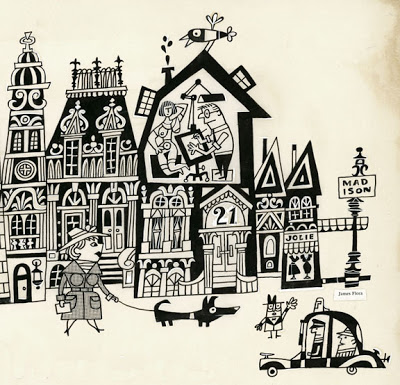
One-half of an undated black and white business card (mock-up) from the 1950s. At the time, though he lived in Rowayton CT, Flora shared an office (and probably an art studio) at 21 East 63rd Street in Manhattan. A classic tempera painting from the period caricatures the neighborhood. No copies of the printed version of this card exist in the Flora collection. The discoloration in the upper right is an aging artifact.
Continue Reading... New York in the 1950s ►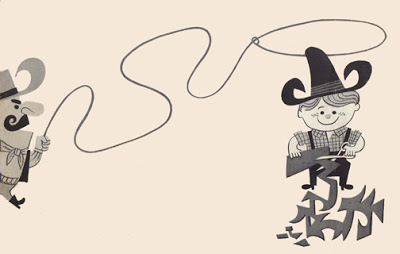
Detail from title page, Charlie Yup and His Snip-Snap Boys, Flora’s third children’s book, 1959. That’s Charlie, snipping away at right; the villain with the lasso is Red Mike. In the book, Red Mike is … red. However, as with many illustrated books of the period, color pages alternated with black and white to make printing more economical. A number of Flora’s kiddie books reflect this trend.
Continue Reading... Red Mike hunts the scissor boy ►
Page from 1957 sales brochure for Electromechanical Design magazine. Flora illustrated an unknown number of covers for this (now long-defunct) monthly. In the 1950s and ’60s, he was often a go-to artist for science-related journalism, as evidenced by his work for Research & Engineering magazine.
Continue Reading... Electromechanical Design ►
