
Filed Under: "1950s"
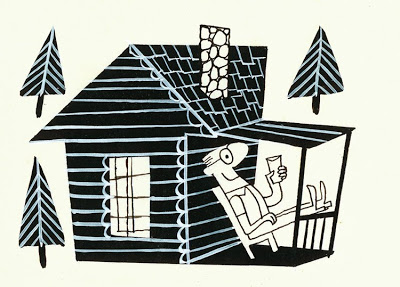
Detail of large-scale illustration for “A Meeting of the Clan at a State Park,” article in New York Times, October 14, 1956. This detail, reproduced (with the full illustration) in our second anthology, The Curiously Sinister Art of Jim Flora, is from a rejected version of the assignment found in the Flora family archives. The published version has similar elements, but repositioned.
Continue Reading... Meeting of the Clan (part 1) ►
Hand-drawn two-page spread of figure studies for Flora’s third book for young readers, Charlie Yup and His Snip-Snap Boys (1959). The pages, which do not appear in the published edition, were scanned from the Dr. Irvin C. Kerlan children’s literature collection at the U of Minnesota. On the mock title page at right, the author refers to the book as “An Old Fashioned Scissor and Paper Adventure.” Although the characters above were drawn in pencil…
Continue Reading... Charlie Yup’s cast of characters ►
Detail from panoramic illustration for article “Arts and the Man,” Park East magazine, May 1953. Flora served as the publication’s art director in 1952, but moved on to full-time freelancing in January 1953. His successor in the Park East AD chair was his longtime colleague Robert M. Jones, who had also succeeded Flora as AD at Columbia Records in 1945. Jones jobbed out several Park East illustration assignments to Flora. The following year, Jones was…
Continue Reading... Arts and the Man (part 1) ►
Partial illustration, “What is Automation,” Collier’s magazine, March 16, 1956. Pull quote from the layout: Automation has been heralded by some as the threshold to a new Utopia, in which robots do all the work while human drones recline in pneumatic bliss. The complete two-tiered illustration—half-utopian (above), half-apocalyptic—was reproduced in our second anthology, The Curiously Sinister Art of Jim Flora.
Continue Reading... What Is Automation? (part 1) ►

That’s the title of the new CD by Seattle’s quirky genre-blending jazz ensemble Reptet. It’s the group’s fourth release to feature a licensed Jim Flora illustration (all usages initiated by the band’s drummer, John Ewing). Information about Reptet, their music, and the gatefold letterpress CD package (designed by Tom Parson) can be found at the Artists Recording Collective. The above image is an inverted detail from Flora’s masterful 1951 woodcut Railroad Town.
Continue Reading... At the Cabin ►
This steamroller is obviously in violation of some vehicular maximum-occupancy statute. The question is—who gets ordered to court? Most likely young Fletcher (at the controls), the only homo sapien on the scene. He’s the most convenient scapegoat (though not the only goat). All the other animals jumped on top of the steam roller as fast as they could. It was the only safe place to be. “STOP!,” everyone was shouting. But the steam roller kept…
Continue Reading... hybrid vehicle ►
Illustration from the cover of Eugene Ormandy & the Philadelphia Orchestra’s 1954 Columbia Masterworks 10″ LP, Richard Strauss: Till Eulenspiegels [sic] Lustige Streiche and Waltzes from Der Rosenkavalier (AL-46). Flora illustrated about a dozen covers for Columbia during his 1943-1950 employment at the label (all released after he relinquished the Art Director chair in 1945). Following a 15-month Mexican hiatus, he rekindled his U.S. freelance career in 1951 and provided a number of work-for-hire illustrations…
Continue Reading... Richard Strauss LP cover (1954) ►
Another pencil draft from the 1955 sketchbook we’ve been featuring the past few weeks. The purpose of this stand-alone drawing is unknown. Other sketches on the same and adjacent pages feature rough panels for a cartoon ad about Proctor toasters; none of those drawings depict a loss of limbs.
Continue Reading... costing you an arm & a leg ►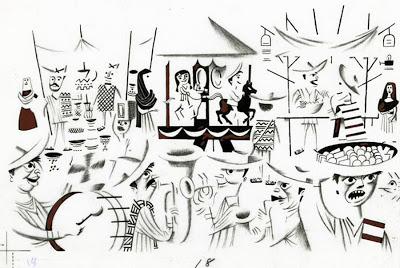
Black ink on vellum overlay of illustration from Flora’s first children’s book, The Fabulous Firework Family (1955). One of numerous such artifacts donated by Flora to the Dr. Irvin C. Kerlan Collection at the University of Minnesota Libraries. Overlays were used to indicate colors for printing. Flora’s books were published over a 27-year span, during which printing processes underwent a number of developments. However, all Flora’s books pre-date digital printing techniques.
Continue Reading... fiesta time ►
Figures from a mid-1950s sketchbook. The two panels were juxtaposed horizontally, but are stacked here for vertical display. The purpose of the drafts is unknown, and the elements are unrelated to any other sketches in the book.
Continue Reading... miscellaneous sketches ►
Our title, not Flora’s. Draft from sketchbook ca. 1955, purpose unknown. Adjacent pages feature rough illustrations of management skills, probably intended for a topical magazine assignment.
Continue Reading... pecking order ►
