
Filed Under: "paintings"

Detail, The Many Aspects of Love, tempera on board, mid-1990s (and pre-dated by a pen & ink drawing). Not a top-tier work, the above partial reflects the extended mayhem. While there’s plenty of vestigial Flora mischief (note demons in the head at left), works like The Many Aspects veer perilously close to self-parody. The complete work has not been published.
Continue Reading... Love (and some of its aspects) ►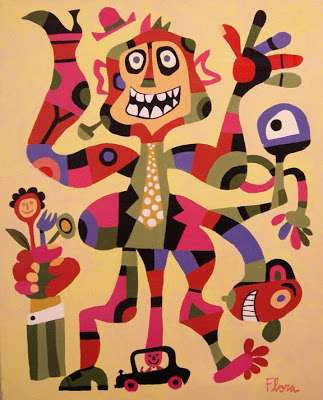
Acrylic on canvas (20″ x 16″), mid-1990s, one of countless unpublished and previously uncirculated (and mischievous and unfathomable) late-life works in the Flora archives.
Continue Reading... The Perils of Overexuberance ►
Quadruped of indeterminate zoological origin; detail, Where Will It All End?, tempera on paper (1993). The full work, previously unpublished, was reproduced in The Sweetly Diabolic Art of Jim Flora (page 66). The rest of the painting is no less disconcerting. Flora was 79 at the time. Many of his 1990s works betray a wobbly hand. Bold ideas continued to flow from the artist’s hallucinatory imagination, but the brushwork was less meticulous than in previous…
Continue Reading... Where Will It All End? ►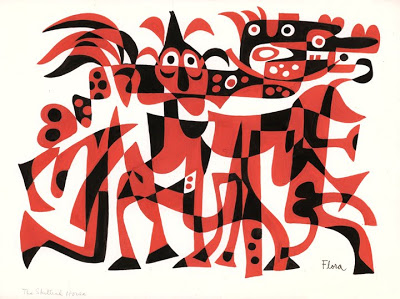
Tempera on paper, mid-1960s. The previously unpublished work was reproduced in our second book, The Curiously Sinister Art of Jim Flora. It’s on our short list to issue as a fine art print.
Continue Reading... Skittish Horse ►
Great detail (extracted at the Print & Pattern blog) from Flora’s mid-1960s painting The Big Bank Robbery. We issued a limited edition fine art print of the work earlier this year. The backstory on the work is unknown. It may be a generic bank hold-up, or based on a specific historic incident. No documentation from the artist is known to exist.
Continue Reading... crimestoppers ►
Detail (about two-thirds of the complete work) of an untitled, unpublished tempera on board, ca. mid-1960s. The collection contains a number of similarly composed maritime paintings from this period, though colors and figures vary. If you have our recent book, The Sweetly Diabolic Art of Jim Flora, compare this setting with Salt Pond—Block Island on page 54.
Continue Reading... seaside setting ►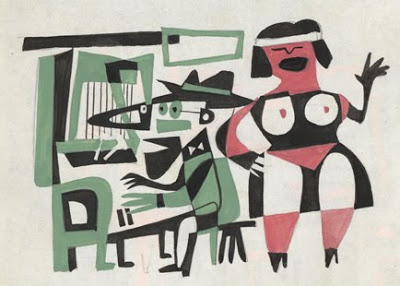
Here are two tempera illustrations discovered in an early- to mid-1960s sketchpad in the Flora collection. The more refined of the two works has a title: Bessie Smith, presumably a vignette of the soulful, bawdy 1920s and ’30s Empress of the Blues. The pianist (great hat!) is unidentified, and we can’t vouch for the historical accuracy of Smith performing with her nipples exposed: The second work, pages away in the same sketchpad, is untitled but…
Continue Reading... Bessie Smith and someone like Bessie Smith ►
Acrylic on canvas, 1992. Irving Milfred “Miff” Mole was a legendary American jazz trombonist who first came to prominence in 1920s hot jazz. Tommy Dorsey called him “the Babe Ruth of the trombone.” Amid the painting’s colorful details, pay special attention to this great freakin’ tree:
Continue Reading... Miff Mole’s Cat ►
Flora loved experimenting with hand-typography throughout his career, from the 1930s to the 1990s. (Click on tag below to see previous examples.) He occasionally created anthropomorphic letters. The above detail derives from an undated 1990s-era painting entitled The Many Aspects of Love. The large-scale tempera is a lower-tier work reflecting Flora’s libidinous streak with cartoonish figures, a recurring theme which usually makes us cringe. However, the lettering of each word in the tableau demonstrates Flora’s…
Continue Reading... aspects (typography) ►
Unfinished figures in tempera and pencil, photographed on sketchbook page. The undated work is probably from around 1960 because the contours resemble Big Evening, a tempera from that year.
Continue Reading... unfinished tableaus ►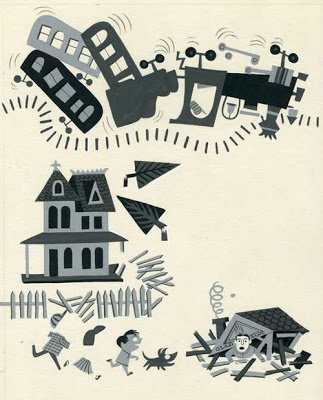
Tempera overlay, The Day the Cow Sneezed, 1957, courtesy the Dr. Irvin Kerlan Collection, University of Minnesota Children’s Literature Research Center.
Continue Reading... cow chaos ►
The title and date of this 1960s commercial tempera illustration are unknown, as is the periodical for which it was assigned (possibly LIFE or LOOK magazine). The mise-en-scène depicts historic incidents and major league baseball players associated with Busch Stadium (a.k.a. Sportsman’s Park), home of two St. Louis baseball teams: the luckless Browns (1902-53) and the perennially contending Cardinals (1920-66). The ballpark was replaced by Busch Memorial Stadium in 1966, an event which this illustration…
Continue Reading... the old brawl game ►
